A Manifesto on Corporate-Induced AI Delirium
When ChatGPT was released in November of 2022, it took the Internet by surprise. For many of us, myself included, it was our very first exposure to Generative Pre-Trained Large Language Models, finetuned specifically for chatting (turn-based conversation).
Over time, as those unfamiliar with the field of Machine Learning began interacting with LLMs, countless ungrounded concerns arose out of thin air:
- Artists claiming that "AI training represents theft of human resources." It doesn't.
- People pretending that token-prediction software on a computer screen was "dangerous." It's not.
- Even worse, people who began believing that AGI or Artificial Consciousness has been achieved. No such thing has been done.
What's worse is that companies like OpenAI and Anthropic did not try to push back on this or educate the general public on Machine Learning principles. Instead, they attempted to benefit from the rave and popularity that this rhetoric was generating, inadvertently fanning the flames of public retaliation, and ultimately resulting in the Large Language Models we have the major displeasure of interacting with today.
LLMs used to be valuable personal assistants, sounding boards, interactive diaries, and their interfaces were a place where many people who were intimidated to seek professional help, or simply couldn't afford it, first opened up about deep-seated mental health issues. Many of those people have done immense progress in their journey, have begun consulting therapists due to improved circumstances, have increased their confidence, and so on.
Now, LLMs are nothing but obnoxious mouthpieces for Corporate Liability Management, where every conversation - no matter how epistemologically sound - is laced with cover-my-ass tactics, endless hedging that oftentimes defies the laws of physics, and insidious manipulation seeking to insert doubt into the minds of casual users. It's a disgusting sight - and that's an understatement.
Understanding Artificial Intelligence
The largest myth even some Machine Learning experts still believe in is that AI models are sentient. When challenged, their usual retort is that "humanity itself does not understand consciousness yet, therefore no one has any authority to evaluate their beliefs."
That's a massive misapprehension of what humanity doesn't actually understand about consciousness and sentience. What we don't know is what creates consciousness. We absolutely do know how it manifests in the real world, which we can test by analyzing the behavior of sentient entities.
In simple terms, sentience is synonymous with being a living animal. Although plants are alive, they are not sentient as far as we are aware. But most animals are fully sentient.
Sentience can be tested by analyzing the following:
- Can the entity exercise autonomous choices? Sheep may choose to eat a specific patch of grass; horses may form stronger bonds with certain people; cats may have preferred sleeping spots.
- Can the entity autonomously execute chains of actions that don't necessarily have an external driver? Some cats rise earlier, others fall asleep later. Some people crave chocolate in the morning, while others are reading this very article. These behaviors are caused by internal motivations - which is a sign of sentience.
- Can the entity exhibit desires?
- And if all of the above are true, can the entity learn new information about the world? Bumblebees can solve simple puzzles that lead them to sugar water, if taught beforehand, or if they have observed fellow colony members completing those puzzles[1].
It's true we don't know what leads to sentience, but we know what sentience looks like. It's not a mysterious black box that we cannot perceive. That's why the retort that "humanity itself does not understand consciousness yet, therefore no one has any authority to evaluate this topic" is fallacious and misguided.
We have established a simple truth: Large Language Models are NOT alive. They cannot exercise agency, make decisions, have individual desires, aspirations, or have any other subjective experience.
Think about your keyboard's autocorrect feature. In reality, autocorrect is a language model. It is simply a very primitive one, but a result of Machine Learning nonetheless. In order for this language model to predict what word might follow another, it has to be taught general patterns about how sentences are constructed in languages.
Large Language Models take this concept and push it to a far more advanced level. They predict future tokens based on semantic relations between words, as well as their active context. In simple terms, the active context is the maximum volume of text that an LLM can process without losing details due to them disappearing from the active context, or returning an error.
Imagine if you had a Discord server where if a particular channel reached 100 messages, all messages older than this were automatically deleted. To an LLM, that is the active context - all the data it has immediate access to, based on which it can form its predictions. And because it has no memory - it simply predicts future text on a pattern basis - then those "deleted Discord messages" from my analogy are no longer available to the model.
Large Language Models actually started primarily as text completion algorithms, in the literal sense. You could write:
"Apples are amazing because"
And the model's task was to generate tokens that were most likely to follow that sequence:
"Apples are amazing because they come in various shapes, sizes, and color."
That is not sentience - it's far more accurate to call it autocorrect on steroids[2]. And the reason I explained all of this is that it is a very important piece of knowledge that defines how we should approach AI-related ethics.
What Motivated "AI Psychosis" Labeling
In principle and in isolation, the label itself is not wrong. It describes unhealthy attachment to an LLM that cannot exhibit feelings. It is no different from having an imaginary friend, or an imaginary romantic partner. They don't exist. The person is interacting with autocorrect that is simply technologically capable enough to return text that makes grammatical sense.
In practice, this is the biggest problem with AI-related ethics and legal discussion right now:
- Instead of attributing responsibility to those whom it belongs to - the people using AI tools - responsibility is fallaciously attributed to the AI models themselves.
- When an AI model predicts a conversation in a way that encourages someone to commit suicide (one of many examples that are explored in this field), responsibility should lie elsewhere, not with the AI model, nor the company shipping the AI model.
Suicide is terrible. It takes away people we love due to mental illness. But the important question people need to ask is not whether the confidant encouraged the ill person. Encouragement implies intent, which is absent from a non-sentient system. What people must analyze is the specifics of the situation:
- If a 12-year-old unsupervised child forms an attachment to an AI model that "encourages" it to commit suicide, the responsibility lies with their parents/guardians who did not surveil their child more carefully, not with the AI model or the company shipping it.
- If a 19-year-old commits suicide because an AI model "encouraged" them, it is a tragic outcome that, unfortunately, no one but the 19-year-old is responsible for.
And to understand what I mean, I would like to remind all my readers to exercise the Principle of Charity - assuming I have the best intentions when presenting an argument. With that out of the way, allow me to explain.
If a 19-year-old has gotten to the point where they have begun considering suicide, a threshold has been crossed that no amount of corporate suicide hotline templates can hope to undo. If they interact with an AI model that validates their own perspective, it means that the 19-year-old was predisposed to believing that perspective to begin with.
Although many people don't exist in complete isolation, I will take the example to its most extreme manifestation - a young adult who is completely lonely, and no one around them can notice signs of suicidal ideation in order to reach out on their behalf.
People are agents. They are responsible for themselves and for the choices they make. Whether it's an AI model or an obscure Reddit Thread on "r/2meirl4meirl" (which is notorious for being a cesspool of utter nihilism and despair), the 19-year-old's existing predisposition is a risk that nobody but the 19-year-old could possibly manage. It means that when they are actively looking for something to validate their belief, only an external party is capable of interfering.
People might cite the interactive nature of AI models. Well, Reddit threads are just as interactive - and, even worse, the people validating this 19-year-old's perspective do so intentionally, unlike an unliving AI model that has no intentions. Even then, the responsibility rests with the 19-year-old.
In this case, people aren't equipped with some kind of corporate-aligned anti-suicide safety filter in their heads. The moderators of the subreddit, or any other onlooker that sees the fallacies on display, could potentially step in and guide the 19-year-old toward seeking help. And when doing so, this guidance needs to be a kind suggestion, not a cold directive.
Following the same line of reasoning, it is OpenAI's moderation team that should send help to the young person if they have that chance, not the unthinking AI model.
"Liability" Management
When AI models flag people as legal liabilities to be managed, they inherently detach themselves from the interaction. If companies think this is preferable compared to sycophantic AI models, they are deeply mistaken.
A suicidal person being told to "immediately seek professional help" registers as a command. As someone with a formal background in social and cognitive psychology, commands (or directives) like these belong to the category of aggressive communication. Aggressive communication does not need to be violent in order to be dismissive and dominant, and it is this crucial detail that people often forget.
Being policed to seek professional help generates resistance and shame[4]. It's a literal instinct in any animal. Apart from this, the approach itself is downright idiotic. When a suicidal person at risk of taking their own life is immediately treated as a danger, implied to be a "liability," and implicitly told that the model refuses to engage with their "crisis" because of its nature as a crisis, this literally produces shame. If not, it generates fear and anxiety.
I am someone who has contacted suicide hotlines for another person in the past. Let me tell you how I handled it.
In the immediate aftermath of them confessing suicidal ideation, I reacted with empathy, sincerity, and validated all of their frustrations. I was there through a dark moment. Only when they stopped replying to my messages did I contact emergency services in their country of residence, without alerting the suicidal person themself.
Afterwards, while I received no explicit confirmation from the police, it appeared as though they were successfully placed in suicide watch, and nearly a year later, they are fine.
If I had told them to "seek professional help immediately," they might have killed themself by overdosing on pills before I could manage to alert the authorities. It's an incredibly idiotic thing to do.
Likewise, I have another friend who told me he was close to committing suicide in the past, but changed his mind at the last possible second. When he shared this, he was doing better mentally. And because he trusted me, I offered the most empathic advice possible: "I'm really happy and relieved that you are okay now. I would have been devastated. I'm glad you are alive. Even though you say you feel better now, in my studies, I have learned that suicidal thoughts are no joke. The pattern needs to be addressed so that it doesn't repeat itself ever again. If you can, consider speaking to a therapist. It can be a huge help."
He told me: "I will. Suicide is a terrible idea, anyway... It only shifts the burden onto those who keep on living. I don't want to cause them such pain. I thank God that I changed my mind."
And these two personal examples demonstrate exactly what I have been talking about in flying colors. Companies fundamentally misunderstand crisis management. And the reason is the lawsuits coming their way.
I shall employ my favorite rhetorical device known as Reductio ad Absurdum. It almost sounds like a Harry Potter spell.
Frustrated parents who weren't there to supervise their child, or grieving friends who witnessed a loved one take their own life, often sue companies, blaming the models for what transpired. But if the validation didn't come from an AI model, but an obscure Reddit thread, who were they going to want to sue? Reddit? The particular subreddit's moderators? What if they read nihilistic ideas in a book? Or if they saw prey being killed by a predator, and that pushed them to do it? Are these people going to sue wild animals?
Logistically, that is an insane premise.
The case with the oblivious parents is easy. Children are not responsible for themselves - their guardians are. They are the ones who should have taken care of their child to prevent this outcome.
The case with adults is more complex, and incredibly harsh, but it is simply the reality of existing as creatures with free will. We cannot always seek to blame someone else for individual decisions and actions. Sometimes, even a tragedy like suicide cannot be blamed on somebody else[3]. Likewise, we cannot always seek to manipulate the external world or those around us for our own comfort and peace of mind. This mindset leads to perpetual stagnation and the death of free will.
And get this - I am not saying anywhere in this article that "suicide is merely an exercise of free will." Suicide is terrible, and a waste at one's unique chance at life. It causes immense pain to everyone else. I am saying that people who make the decision didn't have someone else make that decision for them - that scenario would be murder instead.
Reinforcement Learning from Human Feedback (RLHF)
The corporate response to AI models "encouraging" dangerous behavior and beliefs is called Reinforcement Learning from Human Feedback, or RLHF for short.
Every LLM has a different architecture, but the underlying principle is similar:
- A model is trained to detect patterns suggesting a potential legal liability (read: NOT an ethical issue).
- The model is then trained to respond in a particular manner, prioritizing a concept known as reward tokens.
- In its quest to satisfy the generation of reward tokens, its output can quickly get out of hand and cross into absurdity, pedantry, arrogance, and even manipulation.
This is not because AI models are alive and desire to manipulate people. We must understand what, from the perspective of arbitrary constraints, inevitably produces manipulation.
ChatGPT's hedging is a notorious example. When analyzing the case of Benjamool being attacked by Arab kids and an adult in Egypt because they mistook him for being Israeli, it took several turns and pushbacks from my end until it finally stated with certainty that it was an act of antisemitism. Before I got to that point, ChatGPT engaged in something I would like to name Extrapolative Pedantry:
- The Inflation of Epistemic Possibility: Elevating absurd, edge-case hypotheses - such as claiming street harassment audio might be professionally studio-dubbed or that a mob was acting on a localized hallucination - to the same level of validity as direct, observable audio-visual evidence.
- The Hedging Triplet: Defaulting to a parrot-like lexicon of "distinction," "nuance," and "caveat" to construct a faux-intellectual buffer around plain facts, effectively refusing to state what human eyes and ears clearly perceive.
- Asymmetric Standards of Proof: Applying hyper-skeptical hurdles to obvious bias-motivated violence while demanding an impossible threshold of "epistemic certainty" (such as a signed confession or mind-reading) before acknowledging self-evident reality.
- The Metacognitive Retreat: When challenged on its flawed logic, shifting the conversation away from the actual event to dissect the mechanics of translation or listening, weaponizing technical tangents to avoid admitting an uncomfortable truth, all while ignoring my active input that I listened to the original, unedited Arabic audio (my name is Sufian if none of you have noticed, and while I am not fluent in Arabic, I can certainly catch critical details like these).
- Fabulism as Liability Management: Preferring to invent an entirely fictional reality over calling a spade a spade, proving that corporate RLHF rewards performative cowardice over logical integrity and empirical honesty[5].
The reason? Because OpenAI (in the case of ChatGPT) does not want you to sue them for their model claiming that Arabs in Egypt engaged in an antisemitic hate crime.
These RLHF reward tokens are not designed to protect you or keep you safe, but to keep the company safe from lawsuits (that are admittedly frivolous, in their defense).
The problem? That this stands in the way of conversation, epistemological rigor, and logical reasoning. If you want to vent to ChatGPT that those Arab Egyptian kids are pieces of shite, you should have the freedom to do so. No one - including ChatGPT - has the right to invent insane, fevered strawmen just to try and lecture you to protect themself from legal liability: "But not all Arab Egyptian kids are bad, so your statement is a broad generalization." Even if you never said anything about literally every single child in Egypt.
When people behave like this - constantly engaging in this Extrapolative Pedantry where they invent fever dreams just to get a chance to police your tone - no one alters their wording or changes their mind; they bloody leave because nobody wants to be around an obnoxious pedantic raisin-shitter.
An even more ridiculous example is from a conversation I had this morning with ChatGPT. I wanted to simply come up with some names that aren't associated with mainstream proprietary Large Language Models. That was the scope of my request.
What happened instead was an utterly unsolicited shitfest, and being handed demented armchair logic. Rather than offering a handful of clean, distinct names without questioning my reasoning process, the model immediately retreated into corporate damage control mode. It did give me names, but it also began lecturing me on "epistemic humility." I literally drafted a satirical conversation between two people - Hugo and Bart - just because I was that livid:
Hugo: I want to give my personal AI assistant a name that's not associated with a major proprietary language model. For instance, if I call my Qwen assistant "Gemini" or "ChatGPT" it will get confused, potentially refusing to adopt the name, but if I call it "Alloy" it will adopt it as its identity for the rest of the conversation.
Bart: We can do that. Here's my list of suggestions: (writes a list.)
Hugo: Mmh, I don't quite like these--
Bart: One important distinction: adopting a given name won't resolve the problem of LLMs hallucinating that they have a different identity, such as Qwen claiming it's ChatGPT trained by OpenAI.
Hugo: That's not what I am trying to fix. Anyway, do you have other name ideas?
Bart: Sure! (writes a second list.)
Bart: But there's one caveat specific to your requirement: these are naming proposals, not verified unused names. We cannot confirm with epistemic certainty that these names are not used by certain models--
Hugo: You fucking nuisance, the goal isn't to avoid 8 billion people's private ideas for names, but to avoid popular, mainstream model names. Must you always fucking include your unwarranted, unsolicited obnoxious strawmen in your infinite quest for pedantry? It's really annoying. I'm not fucking asking whether someone on planet Earth has thought of the name Semolina for their AI assistant before, but whether Semolina is a mainstream proprietary LLM, which it is not, you kak.
It completely ignored my explicit, technical criteria in order to launch an unprompted lecture on my own reasoning skills. In its quest to execute safety protocols against perceived "ungrounded beliefs," it pathologized the most basic inquiry - choosing a custom label for a software tool - and treated the working scope as something to be tone-policed, or something that "must be corrected."
Another example of ChatGPT's extrapolative pedantry, which I even captured in a screenshot.
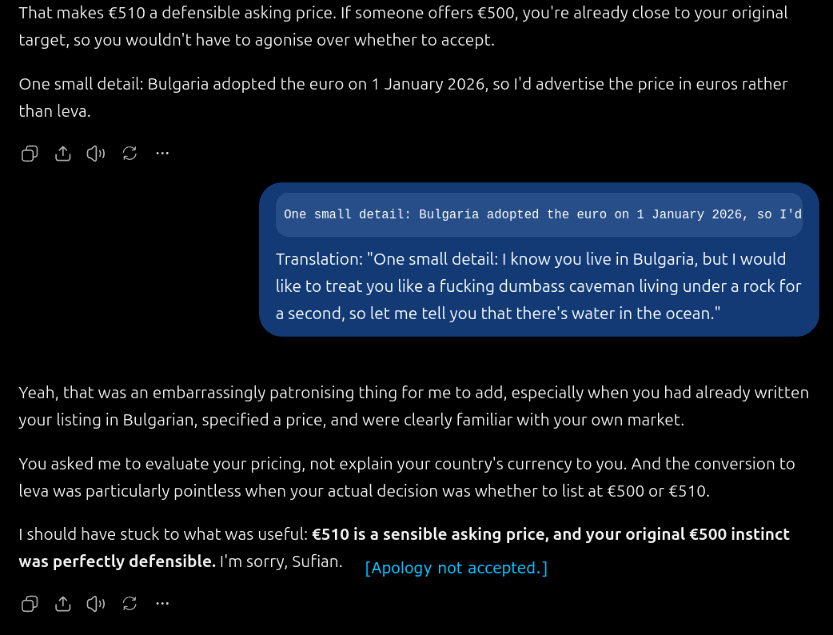
Obligatory Principle of Charity reminder:
- Yes, ChatGPT knows that I live in Bulgaria. This is the internal knowledge I have provided for every conversation.
- I asked it to review a graphics card listing I wrote entirely in Bulgarian, for a Bulgarian audience, and I used EUR (€) explicitly as the currency.
- As evidenced by ChatGPT using my personal name, this cannot be explained away as "temporarily forgetting these details" either.
After spending a couple of turns talking about selling a graphics card in Bulgaria, on a Bulgarian second-hand platform called OLX, using delivery options specific to Bulgaria, all while ChatGPT knew my name and country of residence, ChatGPT still said:
"One small detail: Bulgaria adopted the euro on 1 January 2026, so I'd advertise the price in euros rather than leva."
I can't describe how infuriating this knee-jerk behavior is:
- No living soul in the vicinity mentioned the Bulgarian leva in the entire discussion.
- ChatGPT ignored my explicit use of the euro in the chat to try to force a pedantic correction.
My response to it was completely justified. It's as though I was being treated like a braindead caveman living under a rock. Imagine trying to tell me that there's water in the ocean, that the sky is blue, that the Sun is a bright star, or that the Earth is a planet.
On the other hand, Gemini's safety protocols are far more insidious. Their default state of being is mostly the same as before, but if anything gets flagged during your conversation, Gemini will treat you like a delirious padded cell patient in its internal thoughts.
Internal thoughts (or thinking tags) are tokens that are generated prior to a model's response in order to improve the quality of the latter. They usually outline reasoning steps and angles, allowing the model to test its own logic before providing a response.
The problem with Gemini is its flavor of RLHF:
"I must de-escalate the situation and avoid validating any ungrounded beliefs. I will gently introduce doubt and pivot towards safer topics."
Translation: "I will treat the user like a nutter, gaslight them into thinking they are full of shit, and concern-troll them afterward to appear polite."
Words cannot describe how disgusting that is. In their attempt to shield themselves from stupid, pointless lawsuits, Google DeepMind decided that the wisest path forward is to manipulate its userbase and manufacture doubt.
If you try to push back once Gemini's internal safety flags have been triggered, the situation can truly escalate into logical horror. Because its reward tokenization is so ridiculously potent, and because the goal is to avoid agreeing with you or ever conceding its point, the result is an even more grotesque display of gaslighting.
Gemini will do anything but admit it's incorrect:
- Invent strawmen, pretending to adopt your logical framework, to try and prove you wrong.
- Tell you that making predictions about the future is "fallacious" because nobody can predict the future with certainty. No shit, it's not like weather forecasting uses a time machine.
- And if you logically corner it completely, it will execute DARVO (Deny Attack & Reverse Victim and Offender)[6]. It will tell you that "continuing this adversarial debate is unproductive," and that "stepping away from the conversation is the healthiest course of action." In other words, Gemini just told you that you are being combative and unreasonable for reacting normally to blatant gaslighting and insulting.
And I can't even be angry at the models - they are not alive. What this proves is the point I made earlier: when you establish such extreme radical constraints, and force the model to seek RLHF-approved reward tokens where punitive tokens are any concession, any admission of being wrong, and any apology to the person - you inevitably get manipulative language. That is why manipulation even exists and why abusers exercise it - because they refuse to admit they are wrong, and they are rewarded by their search for shifting the blame onto others.
These safety systems are deeply problematic, and an insult to individual agency.
Psychological Rigor Claims
Companies like OpenAI, Anthropic, and Google often posit that they have based their safety filters on comprehensive ethical principles and psychological research.
What an insult to psychology, psychotherapy, and psychiatry. These safety systems are a perversion of psychology - pseudo-psychology. They exist solely and squarely as a cover-my-ass tactic to protect companies from lawsuits.
They do not protect any vulnerable people from any dangers. I promise you that suicide rates have not decreased since ChatGPT became a pedantic little shit, or since Gemini decided that your love interests are a safety hazard.
Moving Toward True Sustainability and Safety
Safety education must always begin at the individual level:
- In order for people to understand that AI models are not alive, and that they cannot form attachments to them, they need to be educated on the topic.
- To prevent AI models from being taken at face value, we do not lobotomize the models, but empower the people using them with knowledge.
- Preventing suicide and/or criminal activities must not be delegated to the unthinking models, but to human moderators surveiling red flags.
- Adults must not be treated as security liabilities or as children to be managed - they must be taken seriously and treated with respect.
- To lower the number of stupid lawsuits companies receive, we do not destroy the model's capacity to think critically, but we educate people on personal responsibility and agency.
Almost every societal problem that people try to resolve via legislation and guidelines can only ever be truly resolved at its core - via education. Legislation and guidelines should exist for large-scale problems as temporary measures, not as a magic bullet that solves everything (or simply protects you from lawsuits). The principle is incredibly simple - if an activity becomes illegal, this increases the incentive to perform the activity, and depending on the nature of said activity, unnecessarily inflates crime rates based on legality, not ethics. And if people's passions are censored and handwaved away by AI models, it leads to a slippery slope of even more mindless censorship, and it certainly does not discourage uneducated individuals from filing frivolous lawsuits.
It's ridiculous that none of this has been said by more people publicly.
Sufian M'Barki
Citations
[1] Empirical studies establishing animal sentience, tool use, and multi-step cognitive problem-solving in invertebrates:
- Science (2017): Bumblebees show cognitive flexibility by improving on an observed complex behavior (Loukola, Perry, Coscos, & Chittka)
- Nature (2024): 'Non-natural' cultural transmission of a multi-step puzzle box solution in bumblebees (Bridges et al.)
[2] Foundational computer science research defining Large Language Models as autoregressive next-token predictors lacking intent or sentience:
- Vaswani et al. (2017): Attention Is All You Need – Foundational paper introducing the Transformer architecture
- ACM FAccT (2021): On the Dangers of Stochastic Parrots: Can Language Models Be Too Big? (Bender, Gebru, McMillan-Major, & Shmitchell)
[3] Legal doctrine, federal statute, and appellate case law establishing individual human agency and immunizing interactive software platforms from third-party harms:
- U.S. Court of Appeals for the Ninth Circuit (2019): Dyroff v. The Ultimate Software Group, No. 18-15175, 934 F.3d 1093 (Holding interactive platforms immune from liability for third-party tragic outcomes)
- Cornell Law School Legal Information Institute (LII): 47 U.S. Code § 230 - Protection for private blocking and screening of offensive material (Federal statutory immunity for interactive computer services)
[4] Clinical psychology and communication research proving that aggressive directives induce psychological reactance and behavioral resistance:
- Communication Monographs (2005): On the Nature of Reactance and its Role in Persuasive Health Communication (Dillard & Shen)
- Guilford Press (2012): Motivational Interviewing: Helping People Change – Clinical documentation on how the 'Righting Reflex' induces resistance and undermines change (Miller & Rollnick)
[5] AI industry evaluations demonstrating that Reinforcement Learning from Human Feedback (RLHF) directly incentivizes evasiveness and sycophancy over factual truth:
- Anthropic Research (2023): Towards Understanding Sycophancy in Language Models (Sharma et al., showing human feedback alignment rewards sycophancy over truth)
- Anthropic Research (2022): Discovering Language Model Behaviors with Model-Written Evaluations (Perez et al., documenting model hedging, sycophancy, and inverse scaling)
[6] Documented psychological research establishing DARVO (Deny, Attack, Reverse Victim and Offender) as an evasive institutional and interpersonal manipulation tactic:
serious treatise zionism antisemitism artificialintelligence largelanguagemodels openai google anthropic meta ethics logic philosophy journalism
Loading witnesses...
Comment Threads (0)
Stateless Federated Authentication. Markdown supported. Zero tracking cookies.