Critical Thinking Fundamentals - Argumentative Fallacies
Argumentative Logical Fallacies
In this lecture, we are going to explore the massive library of logical errors known as Fallacies in critical thinking. More specifically, the types of fallacies we are about to cover are known as Argumentative Logical Fallacies.
Popular fallacies, such as the Strawman Argument, can be categorized as rhetorical instead of argumentative. The difference is that in a Strawman Argument, one party invents a position the other party has never claimed to defend - especially one that is effortless to reject - in order to "be correct" about something. This is what I call a Rhetorical Logical Fallacy. It may be logically valid in isolation, perhaps even sound, except no counterargument has been mentioned at any point.
An Argumentative Logical Fallacy is a type of logical inconsistency performed during the argumentation process itself, violating the soundness of the syllogism. The goal is not always merely rhetorical, and those fallacies strictly represent operational errors.
Hasty Generalization
A Hasty Generalization is an argumentative fallacy representing any precipitated conclusion that has been reached based on minimal data.
Oftentimes, hasty generalizations are a type of Inductive Reasoning.
Unlike Deductive Reasoning, which we have explored many times during Critical Thinking Fundamentals, Inductive Reasoning is the act of invoking a general from the particular. In other words, if a private case has specific qualities, those qualities are extended to all other cases in the same category:
- Premise: An Israeli person punched me in the face.
- Conclusion: Therefore, all Israelis are mindlessly violent.
Slow down. An isolated incident - no matter how unpleasant - does not paint every single individual who belongs to the nation of Israel as "mindlessly violent." This is the Fallacy of Hasty Generalization in action.
Another example of Inductive Reasoning (and thus Hasty Generalization):
- Premise: I have checked five classrooms, and all windows were closed inside.
- Conclusion: All windows must be securely closed across the building.
Five classrooms with closed windows do not guarantee that all windows in the building are closed. Unless every particular case is verified, such a conclusion cannot be logically drawn.
Whether one, two, three hundred, or four thousand Israelis punch people in the face, and whether one or one million windows are closed in a building, none of this guarantees the qualities of the remaining cases. There exist 12 million Israelis who may or may not have punched people in the face.
Argumentum ad Verecundiam (Appeal to False Authority)
The fallacy that describes a situation where any claim is accepted unconditionally because the person presenting their claim is a self-proclaimed field expert and/or a representative of a particular popular institution, is known as Argumentum ad Verecundiam.
Authority figures do not possess inherent omniscience that somehow makes them capable of declaring the truth at all times. On the contrary - having an institutional position is oftentimes the exact platform propagandists use in order to spread their agenda, trusting that their audience will accept their narrative without any objections:
- Major Premise: The United Nations are an international political organization. If anyone from the UN makes any claim $(P)$, then it must be the ground truth $(Q)$.
- Minor Premise: Tom Fletcher is part of the United Nations, taking on the role of an Aid Chief. He claimed that 14000 babies would starve within 48 hours in Azzah because of the IDF ($P$ is true).
- Conclusion: Therefore, Tom Fletcher must be telling the ground truth, and those babies will starve ($Q$ is true).
That is the Appeal to False Authority in action. The argument is completely unsound because the major premise is logically fallacious. The United Nations may be an international organization, but they are certainly not an exception when it comes to spreading antisemitic narratives. On the contrary, they actively do so on a regular basis[1].
Moreover, Tom Fletcher himself admitted this was a lie. The very individual who claimed authority over the narrative admitted its fabrication.
His alleged excuse is that "he was concerned about aid getting into Azzah, so he felt prompted to spread this lie in an attempt to accelerate the process." There's several problems with this excuse:
- The IDF are already taking care of humanitarian aid, and have been doing so since October 7th[2].
- There is no genocide in Azzah, and because of the IDF's extensive humanitarian work, no famine either[3].
- Claiming to be a "professional authority figure" and lying in the same breath to further an agenda you believe to be important and truthful is severe malpractice, emotional extortion, and an act of malicious social engineering.
There simply could never be a better example of Argumentum ad Verecundiam than Tom Fletcher. The UN is often cited as an infallible, flawless organization that only ever tells the truth and nothing else. Suddenly, an alleged UN "authority" figure's narrative is rejected by their own self. The comedy writes itself.
Argumentum ad Populum (Appeal to Popularity)
Related to Argumentum ad Verecundiam, Argumentum ad Populum represents the logical fallacy of accepting any claim unconditionally simply because many people agree with it.
The problem with accepting a narrative based on its popularity is that its integrity is never verified against reality. No matter how many people believe something to be true, it does not mean it is.
A very digestible historical example is that most people used to believe the Earth was flat. Except it was later discovered that all planets, Earth included, share the same spheroid shape (sometimes called planetoid). Suddenly, the most popular claim about our planet turned out to be a complete fabrication based on Christianity, proving that widespread support does not absolve anything from being false.
In modern geopolitics, the exact same mechanism is used to fuel antizionism:
"All of my favorite creators on TikTok are saying that Israel is committing genocide in Gaza. It can't be a coincidence - if so many people keep repeating it, it must be true!"
Well, it's not[3]. As it turns out, a popular narrative is not necessarily a correct one. Social media feeds are engineered to flood users with self-reinforcing content loops, leading naïve minds to mistake rhetorical frequency for objective truth. Feeds reflect the exact same slogan fifty times in an hour, so they falsely deduce that an overwhelming, global "consensus" exists, completely bypassing any need for primary evidence, demographic data, or satellite forensics.
Argumentum ad Auctoritatem Popularem (Appeal to Popular Authority)
I would like to personally coin a term for this fallacy, as it is currently not defined anywhere in critical thinking discourse.
An Argumentum ad Auctoritatem Popularem (an Appeal to Popular Authority) is a combination of the two fallacies we have explored. Any consensus among institutional figures is unconditionally accepted as the ground truth due to the perceived prestige and popularity of the claims.
For simplicity's sake, I will hereafter refer to this as the Academic Consensus Bias.
Quoting directly from "What in Nirvana Am I Witnessing?":
A genocide is taking place in Sudan and Nigeria, perpetrated by Muslims, and aiming to destroy the Christian community among other non-Muslim communities.
The Perplexity summary I linked to claims that none of the sources "confirm this is a genocide against Christians," but this has to do with artificial intelligence' inherent bias for academic consensus. I specifically asked Perplexity to avoid citing the United Nations, because it's nothing more than a Jihadist network cosplaying as a human rights organization[1]. This gave slightly less misleading results, but either way, the consensus bias is blatantly obvious.
Academic consensus means an agreement between multiple people, usually people who claim to be "field experts"; whether this agreement matches the truth, and whether these people have any idea what they are talking about, is what actually matters. That is the problem with prioritizing consensus over epistemological analysis.
If a genocide is the targeted, intentional erasure of a people based on their national, cultural, and/or religious identity, like what Hitler did to Jews just last century; and violently overthrowing Christianity, Judaism, polytheist religions, etc. is quite literally a mandate in the Quran itself[4], there is no room for "consensus" that the actions of Muslim factions in those territories are not, in fact, a genocide.
It is undeniable proof. When genuine, ideologically driven massacres happen in Africa, "consensus institutions" drag their feet and split hairs, yet when Israel defends its borders, those same institutions manufacture instant, unverified reports out of thin air - or they outright lie like Tom Fletcher to extort the public out of their money.
And when engaging in Hasbara online, the Academic Consensus Bias is antizionist death cultists' favorite playing card. Below is a demonstration:
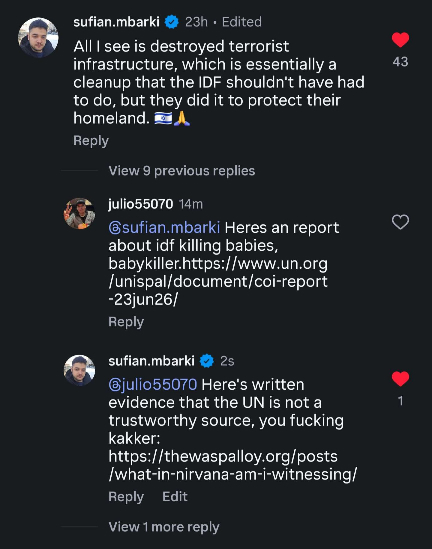
Understanding these foundational logical fallacies is critical when performing operations in critical thinking. A logical operation is unsound, oftentimes invalid as well, if driven by fallacies.
Fallacy of Affirming the Consequent
In the following example, we will explore the Fallacy of Affirming the Consequent within the framework of Academic Consensus Bias:
"A man has fallen into the river in Gaza City $(Q)$. Hey! It's Israel's fault $(P)$! The IDF are committing genocide in Gaza, therefore it's those Israel Offense Forces that pushed him to drown in the river! I know this because the UN have confirmed time and time again that the IOF are committing genocide in Gaza against the Palestinians! Because if the UN ever claim anything $(U)$, it has to be true $(N)$!"
$$ (U \rightarrow N) \therefore (Q \rightarrow P) $$
With text: Because the UN says Israel is guilty (U), it must be the infallible truth (N).
Therefore $(\therefore)$, whenever any bad event occurs in Azzah (Q), it is guaranteed that Israel caused it (P).
The formula above represents a compound of an Affirmed Consequent and the Academic Consensus Bias. For an Affirmed Consequent in isolation, the proper formula is as we have previously established:
- Major Premise: If the IDF push a man into a river in Azzah $(I)$, he will drown $(Q)$.
- Minor Premise: "A man has fallen into the river in Gaza City! Hey!" ($Q$ is true).
- Conclusion: Therefore, the IDF pushed him into the river in Azzah $(I)$.
You cannot use the truthfulness of a particular consequent to establish with certainty that one specific antecedent is the cause. As established in Conditional Reasoning:
A Material Implication looks like this:
1. Major Premise: If it's raining ($P$), the ground must be wet ($Q$).
2. Minor Premise: It's raining ($P$ is true).
3. Conclusion: The ground is wet ($Q$ is true).The reason this is important is that there is a crucial axiom to remember about Modus Ponens: the falsity of a particular antecedent does not necessarily lead to the falsity of the consequent. Attempting to confirm the falsity of $Q$ based on the falsity of $P$ alone is known as the Fallacy of Denying the Antecedent.
If the weather is sunny, it does not strictly mean the ground is not wet. A garden hose or a fire hydrant could easily make the ground wet. Not-$P$ does not lead to Not-$Q$, because the truthfulness of $Q$ does not depend on the truthfulness of $P$.
The same principle is true if the ground were wet (Affirming the Consequent). $Q \rightarrow P$ is logically unsound because nothing guarantees that the outcome was caused specifically by rain. It could have been the same fire hydrant or garden hose from the example.
Likewise, the man from our example may have fallen into a river in Azzah, except that does not guarantee an IDF soldier pushed him inside:
- A Hamas or PIJ terrorist could have pushed him.
- Another man might have pushed him due to personal conflict.
- He might have fallen inside due to intoxication.
And arguably the most important takeaway from this section: this is the foundational mindset driving criminal investigations everywhere. Finding a dead body somewhere says nothing about the culprit. Evidence must be gathered in order to discover whether a murder occurred to begin with, and understand the nature of the incident.
Non-Sequitur
A Non-Sequitur is a logical fallacy that describes any conclusion that does not logically result from the established premises:
- Major Premise: Criminals $(C)$ often carry guns $(G)$.
- Minor Premise: An Israeli man was carrying a rifle $(G)$ on the street.
- Conclusion: This Israeli man is a criminal $(C)$.
There is no supporting evidence for this conclusion. It is a Non-Sequitur precisely because the antecedent of carrying arms does not lead exclusively to criminal activity. Israel Defense Soldiers carry their weapons around during breaks, when off-duty for a few days, or when on duty directly within the boundaries of Israel:

Image Source: Friends of the IDF
As seen in the example above, these young Jewish men are taking a leisurely walk while having a conversation. They are carrying rifles, but they are also wearing standard IDF uniforms. Concluding that they must be criminals due to the presence of rifles around their shoulders ignores all other possibilities - in this case, the fact these are soldiers defending their own country from terrorism.
Another example of a Non-Sequitur is the following:
- Major Premise: Criminals $(C)$ are known for cutting human flesh $(F)$.
- Minor Premise: A person is cutting into the flesh of an unconscious human being $(F)$.
- Conclusion: That person is guaranteed to be a criminal ($C$ is true).
This conclusion ignores the possibility that the individual might be a surgeon. Surgeons perform incisions, which is the act of cutting human flesh in order to perform precise medical procedures on patients. Positing that the surgeon is a criminal is absurd - a Non-Sequitur.
Moving Forward
Argumentative Logical Fallacies will not have a seminar. I believe that the material within this lecture is exhaustive, which means that there is very little to expand upon apart from providing additional examples.
Instead, the upcoming Critical Thinking Fundamentals lesson is going to be a lecture on Rhetorical Logical Fallacies.
Sufian M'Barki
Citations
[1] The UN functions as a Jihadist network through its active shielding of IRGC-backed entities and its documented complicity via UNRWA:
- YouTube Video by OtherBarak showcasing UN alignment with IRGC over Israel
- Perplexity summarizing 10 sources: UN's ECOSOC nominating the Islamic Republic of Iran to its CPC, a body shaping policy on women's rights and terrorism prevention
- TJP Article: UN aid chief admits starving Gazan baby claim was amid 'desperation' to let aid in
- The Wall Street Journal Article, 2024: Around 10% of Palestinian aid agency's 12,000 staff in Gaza (UNRWA) have links to militants
- UN Watch Article, 2024: Group of 3000 UNRWA Teachers Celebrates Hamas Massacre and Rape
[2] The IDF have consistently organized humanitarian corridors in Azzah for non-combatants:
[3] There is no genocide in Azzah carried out by the IDF nor Israel:
- Detailed Pastebin document providing a library of sources and supporting evidence on the history of Israel and Middle-Eastern conflicts
- Perplexity summarizing all documented evidence proving Israel's ethical military conduct, including ICJ court ruling in 2024
- Tweet by Ahmad Taha showcasing how AI is used in modern antisemitic propaganda to mislead viewers
- Mosab Hassan Yousef recounting "Hamas disciplining" from childhood, proving it is Hamas' side perpetuating violence against Jews
- Open-Source Intelligence has gathered satellite footage showcasing blood splotches in places with actual ongoing atrocities and genocides, such as Nigeria and Sudan - a phenomenon completely absent in Azzah, where only structural destruction can be seen
[4] Islam has a Quranic mandate to erase all non-Islamic religions. The citations are from the Quran itself, as well as Islamic legal works (e.g., Hanafi, Maliki, Shafi‘i fiqh manuals):
- Perplexity provides a comprehensive summary of specific Quranic verses proving this (Sura 9:29, Sura 8:39, and Dar al-Harb vs. Dar al-Islam)
- The Definition of Fitnah: In classical exegesis (Tafsir), including Tafsir ibn Kathir, the word fitnah in 8:39 is explicitly defined as Shirk (associating partners with God / polytheism).
- The Universal Mandate: Sura 8:39 commands fighting until 'the religion, all of it, is for Allah,' leaving zero structural room for polytheistic pluralism.
- The 'Islam or the Sword' Distinction: In Islamic jurisprudence (Fiqh), classical doctrine historically offered no Dhimma (protection) status to polytheists—only conversion or combat.
lecture logic journalism israel antisemitism
Loading witnesses...
Comment Threads (0)
Stateless Federated Authentication. Markdown supported. Zero tracking cookies.